The Science in Your Flashcards
Matrics, let's be honest. No one taught us how to study.
Here's what we were supposed to know (but didn't):
During my rewrite, I discovered that for information to stick, it has to go through two stages.
Learn It
Learning new things in class (storing information in our working memory).
Link It
Revising concepts after class (storing information in our long-term memory).
During tests, we rely on our long-term memory — accumulated during the Link It stage. The problem? Most of us never fully reach this stage.
The bridge between Learn It and Link It is the revision method we choose. And for too long, we've been picking the wrong ones:
Science shows there is an effective way to move information from Learn It to Link It. Active recall and spaced repetition are the answers.
Active Recall
Refers to actively retrieving information from your brain — testing yourself without looking at the answer first.
Spaced Repetition
Refers to spacing out your revision across multiple days instead of one big cramming session.
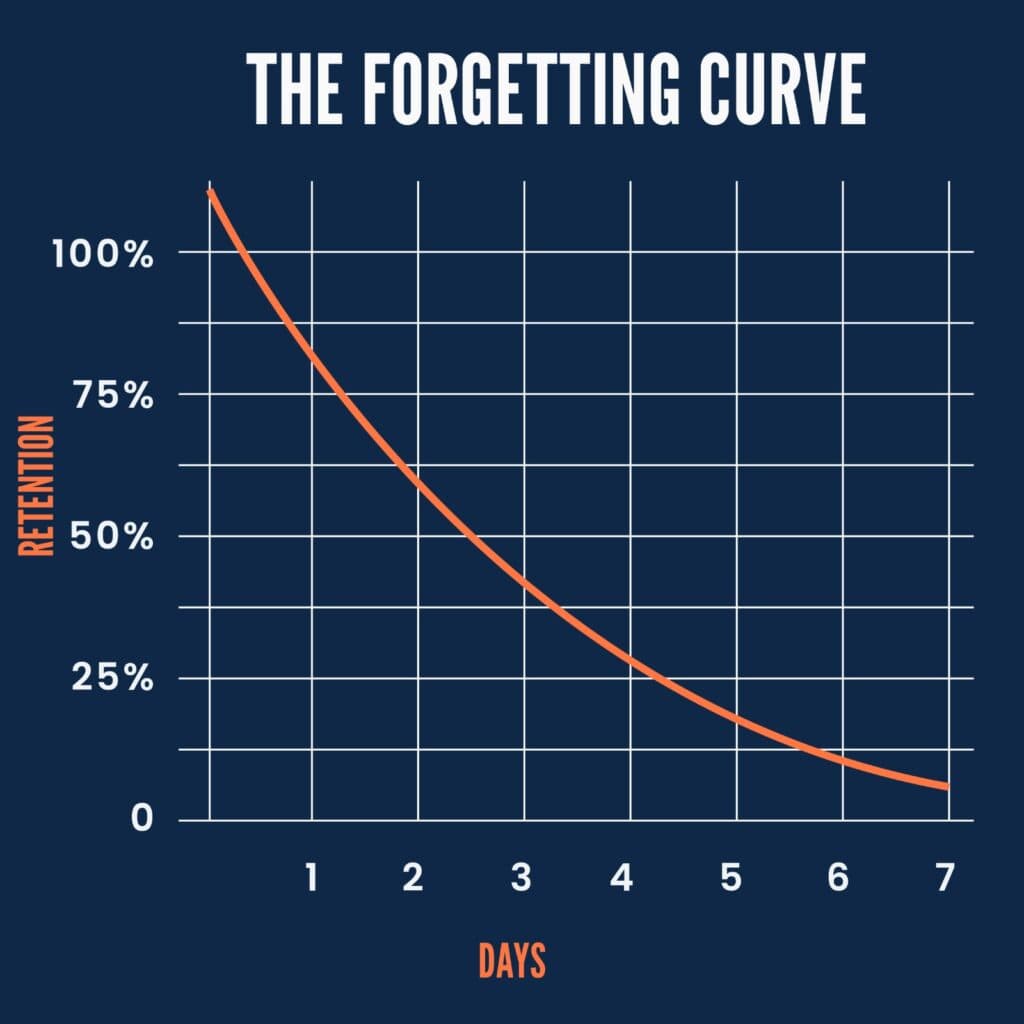
These two techniques work because spacing out your testing helps combat the forgetting curve, the natural way we forget information right after learning it in class.
The first time you learn something, your memory is strong (nearly 100%). But as days pass without review, that memory rapidly declines until it’s forgotten, which is why the graph starts high and fades over time.
In other words, consistently testing yourself is the fastest, most reliable way to actually learn and remember maths.
Why did I score 60% and not a distinction?
I'm glad you asked.
Initially, I thought I was set, since I had just collected an infinity stone for how to kill this paper. Until I discovered my next problem. I still needed to manually track which topics I had studied and how far I was from mastery.
The real question became, “What does mastery actually look like?”
The admin of figuring this out took almost as much time as the actual studying and slowed down my progress.
Then it hit me. Since the objective of the exam is to get as many marks as possible, the objective of studying should be the same.
A-Peer Flashcard Levels
So we created the flashcard levels.
1–2 mark questions
Fundamentals
3–4 mark questions
Application
5+ mark questions
Problem-Solving
Master each level → the app promotes you automatically.
The new question for mastery becomes:
“Have I reached the final level before my paper?”
You're not cooked in maths.
You just need a smart way to study it.
Education Partners
Margaret Conradie | Curriculum Advisor

Provides curriculum guidance to ensure our flashcards are aligned with the CAPS curriculum and assessment standards.